

Introduction
Ships and various types of equipment operating in marine environments face different protection challenges compared to assets located in land-based environments. Almost every part of a ship, including the hull, deck, tanks, piping, various marine equipment, and steel structures, can be exposed to seawater, high humidity, salt content, and continuously changing environmental conditions.
These conditions make corrosion on ships an important aspect to consider in asset management and maintenance. Seawater contains salts and ions that can increase the electrolyte conductivity on metal surfaces, allowing the electrochemical processes that cause corrosion to occur more readily. Combined with humidity, oxygen, temperature changes, and operating conditions, steel surfaces can gradually deteriorate.
Uncontrolled corrosion can affect surface condition and increase maintenance requirements. Under certain conditions, progressive damage can also make repair work more complex and require additional time and costs.
One method commonly used to help protect ship surfaces and steel structures is marine coating. A coating system is designed to form a protective layer over the material surface, helping reduce direct contact between steel and seawater, oxygen, salt, and various other aggressive substances.
However, is coating really effective in preventing ship corrosion?
Coating effectiveness does not depend solely on the type of paint being used. Surface preparation, coating system selection, environmental conditions, application methods, coating thickness, and maintenance are interconnected factors that can determine protective performance.
Why Does the Marine Environment Accelerate Corrosion?
The marine environment is one of the more aggressive conditions for metal-based materials. Ships and marine equipment can experience continuous exposure, both while at sea and when located in ports and supporting facilities.
Seawater is one of the main factors because it contains various dissolved minerals and salts. When seawater remains on a steel surface, these electrolytes can facilitate the movement of ions involved in the electrochemical corrosion process.
In simple terms, corrosion on steel can occur when the metal surface interacts with water and oxygen. In a marine environment, the presence of salt can make these conditions more favorable for corrosion to occur.
In addition to seawater, high humidity is also an important factor. Steel surfaces that frequently remain damp or experience condensation can develop a thin layer of water that allows corrosion reactions to take place.
Temperature changes can also increase protection challenges. Differences in temperature between day and night, changing weather conditions, or temperature differences between the surface and its surroundings can cause condensation on metal surfaces.
On ships, these conditions can occur across different areas with varying levels of exposure. Underwater sections, areas frequently exposed to seawater spray, decks, and areas affected by salt spray can each experience different exposure levels.
The Impact of Corrosion on Ships, Marine Equipment, and Steel Structures
Corrosion on ships is not only associated with discoloration or visible rust on the surface. If allowed to develop without proper control, corrosion can gradually lead to material degradation.
On the hull, for example, steel surfaces face intensive exposure to the marine environment. Certain areas may also experience a combination of seawater, abrasion, impact, and marine organisms, making their protection requirements more complex.
On decks and steel structures, exposure to water, humidity, salt spray, and operational activities can accelerate surface deterioration.
Meanwhile, marine equipment, piping, tanks, support structures, and various steel components can also face corrosion risks, particularly in areas that are difficult to clean or inspect regularly.
When a coating begins to deteriorate, the steel surface can once again become exposed to the environment. Coating areas that are scratched, peeling, cracked, or experiencing blistering may require attention as part of a maintenance program.
If surface damage is not addressed promptly, work that initially requires only touch-up or localized repair can develop into more extensive surface preparation and recoating work.
Therefore, corrosion protection for ships needs to be viewed as part of asset maintenance and corrosion management, rather than simply a painting activity.
How Does Marine Coating Help Prevent Corrosion?
Marine coating is a coating system designed to provide protection for materials used in or exposed to marine environments.
The main principle of coating is to create a barrier or protective layer over the material surface. This layer helps reduce direct contact between steel and seawater, oxygen, salt, humidity, and other aggressive substances that can contribute to corrosion.
With a protective layer in place, the external environment does not come into direct contact with the steel substrate. This can help slow down surface degradation and maintain material condition throughout a certain period of service.
However, coating does not mean that steel becomes completely immune to corrosion. Its protective performance depends heavily on the quality of the overall coating system and how it is applied.
A Coating System Is More Than Just a Single Layer of Paint
In marine coating applications, the protection system may consist of several layers with different functions.
In general, a coating system may include a primer, intermediate coat, and topcoat. The primer serves as the initial layer that helps establish adhesion with the substrate and provides initial protection.
The intermediate coat can provide additional thickness and protection against the environment. Meanwhile, the topcoat serves as the outermost layer exposed to environmental conditions while providing additional protection and surface finishing.
The number of layers and types of coating used may vary depending on the area, material, exposure level, and job specifications.
This means that marine coating effectiveness should not be assessed simply by whether a surface has been painted. The coating system must be designed according to specific protection requirements.
Surface Preparation Determines Coating Performance
One of the most important factors in the success of marine coating is surface preparation.
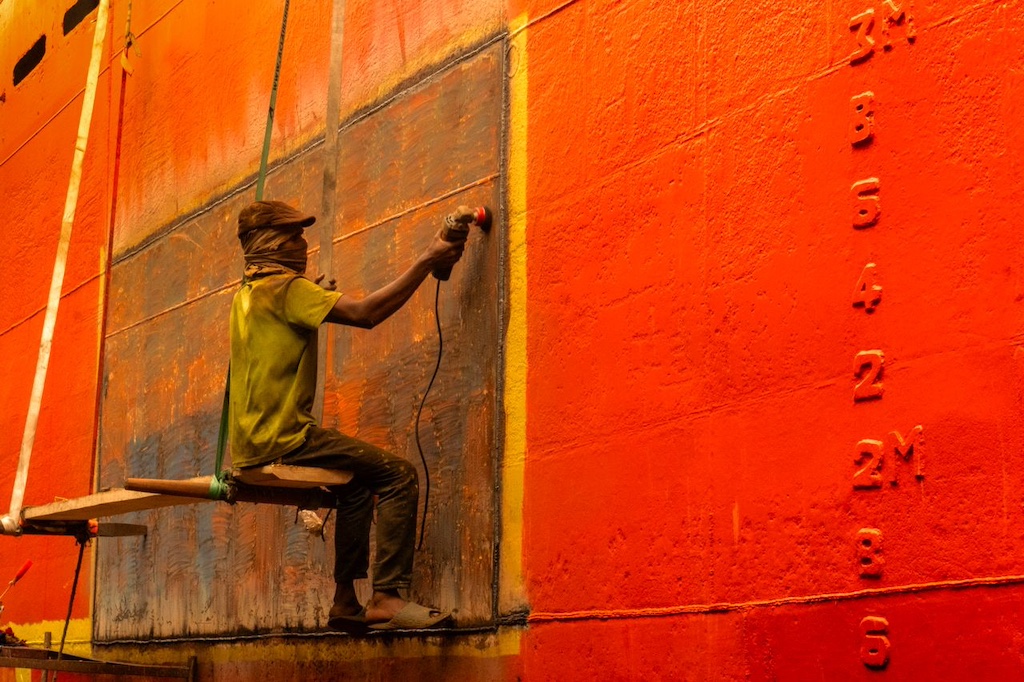
Before coating is applied, the steel surface must be prepared so that it is in an appropriate condition. Rust, oil, grease, dust, salt, moisture, mill scale, old coatings, and other contaminants can interfere with adhesion between the coating and the substrate.
If coating is applied to a surface that remains contaminated, the coating may experience problems such as poor adhesion, blistering, peeling, cracking, or other forms of coating failure.
Therefore, surface preparation needs to be adjusted according to the material condition and coating system specifications.
The methods used may include cleaning, degreasing, mechanical preparation, and abrasive blasting or sandblasting for certain conditions.
In marine coating work, controlling salt contamination on the surface is also an important consideration. A surface that appears visually clean may not necessarily be free from contaminants that can affect coating performance.
With proper surface preparation, the coating has a more suitable surface condition for establishing adhesion and delivering the expected protection.
Coating Systems According to Area and Marine Conditions
Not every part of a ship is exposed to the same level of environmental conditions. Therefore, marine coating systems need to be adapted to the area, exposure level, operating conditions, and protection requirements.
1. Areas Immersed in Seawater
Parts of a ship that remain continuously underwater have different exposure characteristics. The surfaces may experience long-term contact with seawater as well as other factors such as marine organisms and underwater environmental conditions.
These areas require coating systems designed for immersion conditions and the marine environment.
2. Splash Zone
The splash zone is an area that may alternate between wet and dry conditions due to seawater splashes and water movement.
This area can experience highly aggressive conditions because the surface repeatedly undergoes exposure to water, oxygen, salt, and drying.
Because its characteristics differ from areas that are fully immersed or entirely above water, coating system selection needs to take these conditions into consideration.
3. Above Water and Marine Atmosphere
Parts of a ship located above the waterline can still be exposed to humidity, marine air, and salt spray.
Decks, superstructures, railings, and other steel structures can experience repeated salt deposition and moisture exposure. Coating systems in these areas need to account for marine atmospheric exposure and operating conditions.
4. Internal Areas
Internal parts of a ship are not necessarily free from corrosion risks. Tanks, compartments, piping, and certain enclosed areas can experience humidity, condensation, or exposure to specific materials.
Therefore, coating requirements for internal areas need to be determined based on environmental conditions and the type of material present inside.
Factors That Determine Marine Coating Effectiveness
The effectiveness of coating in protecting ships and steel structures is influenced by several interconnected factors.
1. Substrate Condition
The initial condition of the steel should be inspected before determining the appropriate surface preparation method and coating system.
2. Environmental Exposure Level
The type and level of exposure to seawater, salt spray, humidity, chemicals, abrasion, and temperature changes need to be considered.
3. Coating System Selection
The types of primer, intermediate coat, and topcoat should be selected according to the area and operating conditions.
4. Surface Preparation
The surface must meet the required level of cleanliness and surface profile for the coating system.
5. Application Method
Application techniques, coating thickness, environmental conditions, and curing time can affect the final result.
6. Inspection and Maintenance
The coating should be inspected regularly to identify damage before it develops into a more significant problem.
How Can Marine Coating Service Life Be Maximized?
Marine coating continues to face environmental exposure throughout a ship’s operation. Therefore, maintaining coating service life requires an ongoing maintenance approach.
Regular inspections can help identify signs of damage such as rust spots, peeling, blistering, cracking, scratches, or changes in surface condition.
Areas with localized damage can be evaluated to determine whether touch-up is sufficient or whether more comprehensive surface preparation and repair are required.
Surface cleanliness also needs to be maintained. Salt, dirt, oil, and other contaminants should not be allowed to accumulate over long periods because they can increase the burden on the protection system.
Maintenance programs should also consider the actual condition of the asset, exposure levels, and the history of previous coating applications. This allows decisions regarding touch-up, repair, or recoating to be based on inspection results and technical requirements.
Marine Coating as Part of Corrosion Management
Protecting ships against corrosion requires a planned approach. Coating is an important component, but it is not the only element of corrosion management.
Inspection, cleaning, surface preparation, coating application, maintenance, and monitoring are interconnected activities.
This approach helps companies not only respond after corrosion has developed, but also identify risks at an early stage and plan maintenance activities based on asset condition.
For companies managing ship fleets or various structures and equipment in marine environments, systematic coating management can also help organize maintenance requirements and reduce the potential for unplanned repair work.
Conclusion
So, is coating effective in preventing ship corrosion? Marine coating can be an effective protection method for helping reduce direct exposure of steel surfaces to seawater, oxygen, salt, humidity, and other aggressive substances.
However, its effectiveness depends heavily on the overall system. Surface preparation, coating system selection, suitability of the coating for the area and marine conditions, application methods, as well as inspection and maintenance all play important roles in determining protective performance.
The marine environment is complex, meaning that not every part of a ship can use the same coating approach. Immersed areas, splash zones, above-water sections, and internal areas have different exposure levels and require their own technical considerations.
With proper surface protection planning, companies can help maintain the condition of ships, marine equipment, and steel structures while managing maintenance requirements more systematically.
For industrial coating and surface protection requirements, Hasgara provides solutions that can be adapted to surface characteristics, environmental conditions, and asset operational requirements. The right approach can help support asset protection and long-term maintenance management.
Read other Articles: Rust on Ships and Industrial Equipment: Impacts and Prevention